





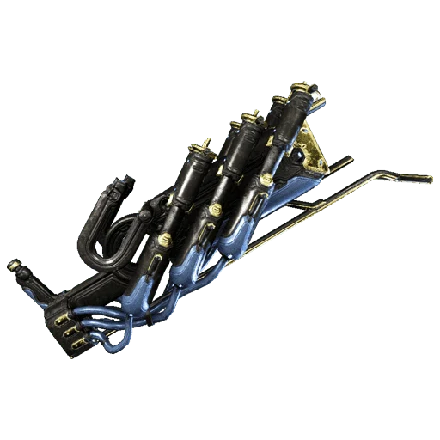
Understand Morgha
Useful when…
- Using the auto-burst primary and its separate impact and explosion entries.
- Using the described secondary air-burst mortar and its separate attack entries.
Primary and charged-shot entries
The auto-burst primary entries list a projectile impact dealing 32 Impact and a separate explosion dealing 164 Blast. Both list 30% critical chance, a 2.2× multiplier, and 28% status chance. Primary explosion falloff ends at 3 metres, with 30% reduction at that endpoint. The charged-shot entries list 40% critical chance, a 3× multiplier, and 50% status chance; its explosion entry lists 600 Impact, 1,000 Slash, 800 Puncture, and 1,200 Blast. That explosion’s falloff ends at 20 metres, with 60% reduction at that endpoint. The attack entries do not specify a charge time or projectile type for the charged shot.
Life-essence interaction and handling
The description says the primary’s double-barreled slugs siphon life essence, which is used to generate the secondary fire’s massive air-burst mortar. The magazine holds 100 rounds and reloads in 3 seconds. The primary is projectile-based with listed speed 160; the listed accuracy is about 6.67. It has one base Madurai polarity.
Other firing patterns
Mausolon is described with automatic primary fire and a charged beam secondary. Cortege is a heavy flamethrower with a fan of explosive secondary projectiles. Kuva Ayanga is described as an automatic grenade-launching Arch-Gun. These are distinct patterns; Morgha’s description identifies its secondary as an air-burst mortar without specifying the charged shot’s projectile behavior or charge time.
Limitations and tradeoffs
- The primary attack is projectile-based and has listed accuracy of about 6.67.
- The primary and secondary attack entries have separate damage and critical/status values.
- The attack data does not specify charged-shot charge time or projectile type.
Common mistakes to avoid
- Calling the secondary a charged mortar with established charge behavior.
- Assuming the charged-shot entries establish projectile type or charge time.
- Calling the 3-metre and 20-metre falloff endpoints blast radii.