




Understand Ripkas
Useful when…
- Use normal attacks for the listed Slash-heavy melee profile.
- Use regular slams for their separate Impact area attack and heavy slams for their Blast area attack.
- Account for the 0.6-second heavy-attack wind-up when choosing when to commit to a heavy slam.
Normal attacks and handling
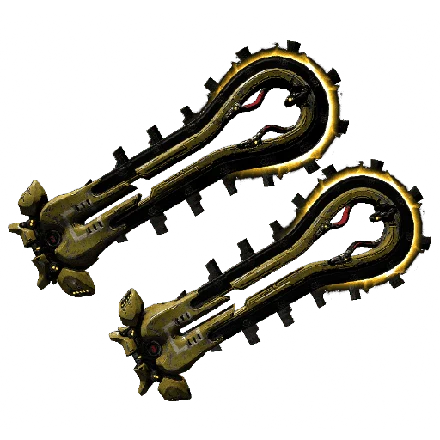
The normal attack lists 8.65 Impact, 17.3 Puncture, and 147.05 Slash damage, with 20% critical chance, a 2× critical multiplier, and 15% status chance. Its listed speed is 0.883. Ripkas has 1.75 m range, 0.8 follow-through, a 55° blocking angle, and a 5-second combo duration. One Madurai polarity is listed.
Keep slam modes separate
Regular slams are area attacks listing 346 Impact, 10% status chance, and 50% falloff reduction by 6 m. Heavy slams are separate area attacks listing 519 Blast, 10% status chance, and 30% falloff reduction by 7 m. Both list 20% critical chance and a 2× multiplier. The heavy attack has a listed 0.6-second wind-up; do not apply the normal attack’s Slash damage or 15% status chance to either slam mode.
Choosing among melee forms
The comparison options have different forms: Dual Keres is a dual sword, Ack & Brunt is a sword and shield, and Amanata is a polearm. Amanata’s description says it rolls for a Koumei blessing after every 30 hits and that a roll of 6 grants all blessings at once; it does not specify the number of blessings. These descriptions identify differences in weapon form or stated effect, not a performance ranking against Ripkas.
Limitations and tradeoffs
- Normal attacks are strongly weighted toward Slash, while slam modes have different damage types and status chances.
- The 1.75 m listed range and 0.6-second heavy-attack wind-up shape melee spacing and timing.
Common mistakes to avoid
- Applying the normal attack’s Slash-heavy profile to either slam mode.
- Using the normal attack’s 15% status chance for slams, which list 10%.
- Saying Amanata’s roll of 6 grants a fixed number of blessings; its description only says it grants all blessings at once.