





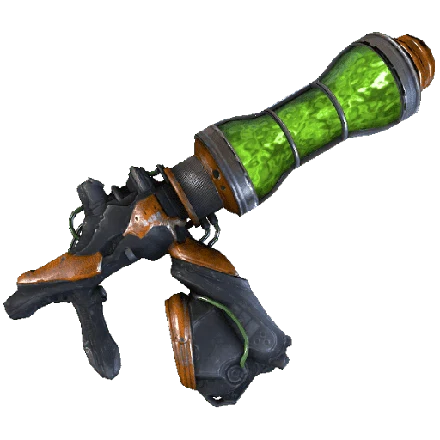
Understand Acrid
Useful when…
- Applying repeated toxin projectile hits with a semi-automatic secondary.
- Using a sidearm with a short 1.2-second reload and 100 listed accuracy.
What does each shot do?
Acrid's normal attack is a projectile dealing 43 Toxin damage, with no listed Impact, Puncture, or Slash damage. It has 5% critical chance, a 2× critical multiplier, and 10% status chance. The weapon is semi-automatic, fires at a listed rate of 5, and has projectile speed and flight values of 65. Its 15-round magazine and 1.2-second reload support repeated shots, but each shot requires a trigger press.
What improvements make sense?
Its base profile is strongly status-leaning relative to critical chance: 10% proc chance compared with 5% critical chance. That can inform mod choices, but the useful investment depends on the mods available and intended content. It has no listed polarity information here, so there is no supported slot-matching recommendation. The construction recipe lists a Forma among its components, along with Bio Components, Nano Spores, and Salvage; it requires Mastery Rank 7.
How does it compare with other sidearms?
Bolto is also a projectile pistol, but its description emphasizes slow, heavy bolts that can impale enemies to walls. Bronco Prime is a shotgun sidearm with a lower listed Mastery requirement of 4, while Cyanex is described as fully automatic, with homing ricochets and an alternate-fire magazine burst. Those are different handling choices; the comparison does not provide enough detailed stats to rank their damage against Acrid.
Limitations and tradeoffs
- Low listed critical chance makes a critical-first plan less directly supported by its base profile.
- Semi-automatic firing requires repeated trigger presses.
- A 15-round magazine limits how long it can fire before reloading.
Common mistakes to avoid
- Treating the listed 10% status chance as a guaranteed status effect on every hit.
- Expecting automatic fire; Acrid is semi-automatic.
- Planning around critical hits without accounting for its 5% base critical chance.