





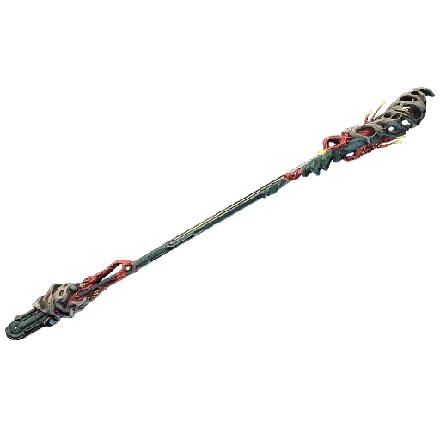
Understand Pupacyst
Useful when…
- Close-range melee with innate Impact and Viral damage.
- Regular area slams with mixed Impact and Viral damage.
- Heavy slams when their separate Impact and Toxin damage profile is useful.
How do the attack modes differ?
Normal attacks deal 139 Impact and 145 Viral damage, with 13% critical chance, a 1.5× critical multiplier, and 27% status chance. Listed attack speed is 0.833. The regular slam is an area attack with 296.62 Impact and 271.38 Viral damage; its status chance is 29%, and damage falls off to a 50% reduction at 7 m. The heavy slam is another area attack, dealing 387.27 Impact and 464.73 Toxin damage, with 37% status chance; its listed falloff reaches a 30% reduction at 8 m. Do not assume the heavy slam retains the regular slam’s Viral component: the supplied mode data gives it Toxin instead. Pupacyst has 2.7 m listed range, a 5-second combo duration, and a 0.9-second heavy-attack wind-up.
What makes its profile useful?
Pupacyst changes its elemental mix by attack mode: Viral appears on normal attacks and regular slams, whereas Toxin appears on the heavy slam. This makes it a more specific choice than a weapon whose modes all share the same listed damage types.
How does it compare with other listed options?
Mire is a sword requiring Mastery Rank 5, with 9% critical chance and a 1.5× multiplier; its description specifically says ground slams deal Toxin. Pathocyst is a glaive requiring Rank 9, with 15% critical chance and about a 2.1× multiplier; its description mentions Viral strikes and occasional enemy-seeking maggots. Skiajati is a Nikana requiring Rank 11, with 19% critical chance and about a 2.1× multiplier. These summaries establish different weapon types and described traits, but do not provide comparable attack handling. Choose among them based on the stated weapon form and properties rather than assuming they play alike.
Limitations and tradeoffs
- Critical chance is 13% and critical multiplier is 1.5× on the listed normal and slam modes.
- The 0.9-second heavy-attack wind-up is longer than the listed regular attack speed might suggest.
- Damage type and status chance vary by attack mode; heavy slams extend to 8 m rather than the regular slam’s 7 m.
Common mistakes to avoid
- Assuming the heavy slam deals Viral damage because the normal attack and regular slam do; its listed elemental damage is Toxin.
- Using the normal attack’s 27% status chance for every mode; regular and heavy slams list 29% and 37%.
- Ignoring the longer heavy-attack wind-up when planning repeated heavy slams.